
Should you build your own booking system with AI?
AI can build a booking demo in a weekend. Here is what it takes to run real bookings, memberships and payments after that, and when building your own makes sense.
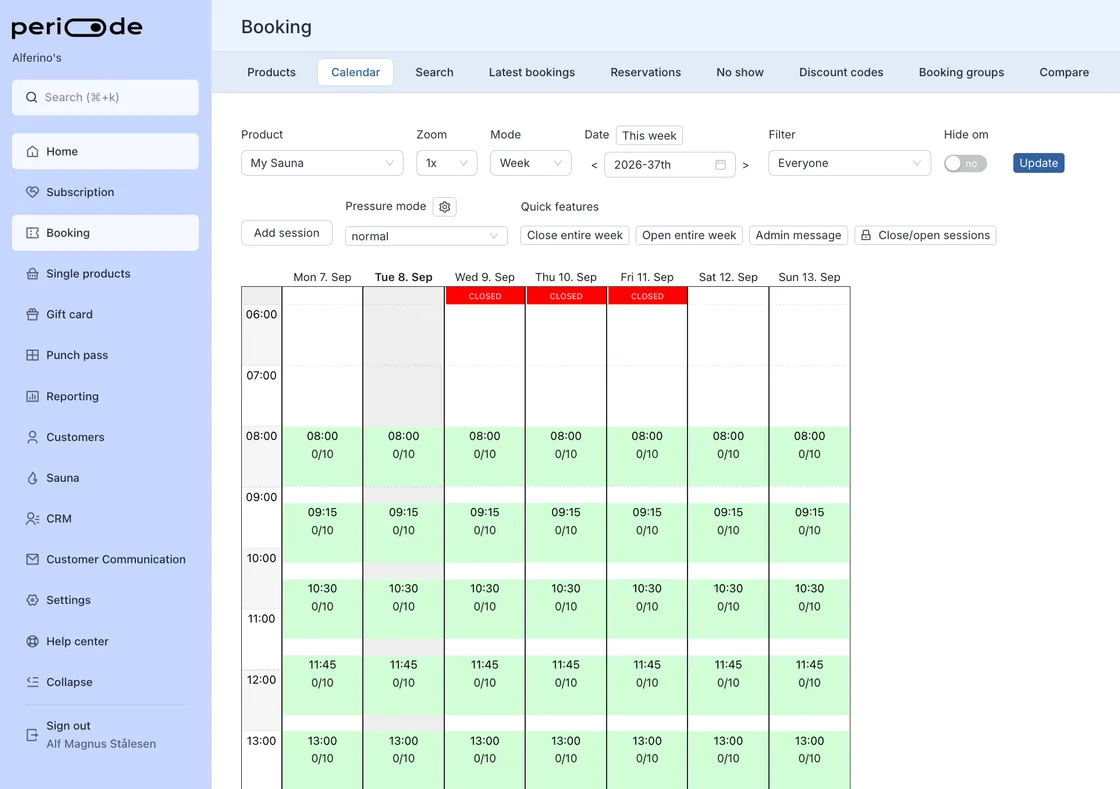
Saturday morning you open Claude Code, Cursor or Lovable. By Sunday evening you have a booking calendar, a card checkout and a confirmation email. It works, and it looks good. Then Monday comes.
AI can do this, and we use it to build Periode every day. But after five years of running bookings, memberships, gift cards and payments for saunas in 13 countries, we have learned that writing the code is the easy part. Running it every day, for years, is the hard part.
What the demo does not show
These things happen once real guests start booking, usually at the worst moment:
- Two guests book the last place in the same second, and both get a confirmation.
- The clocks change, and your 07:00 session moves to 08:00 for everyone who booked before.
- A member’s card expires, the renewal fails without a warning, and they keep coming for four months.
- A bot finds your booking form and sends thousands of SMS messages, on your bill.
- The door lock stops working, and 20 guests are standing outside at minus 15.
Each one needs a decision, some code and a test. Most only show up once real guests are booking.
Security and hacking
The most common problem is not a clever hacker. It is a wrong default. In 2025 two developers checked 1,645 apps built with Lovable and found 170 where anyone could read other people’s personal data. The same year, Veracode tested code from more than 100 AI models and found security flaws in 45% of the tests.
In a booking system, the classic mistake is that one guest can see another guest’s bookings, phone number or gift card just by changing a number in the address bar. AI tools often write this bug, because everything works when you test it as yourself.
GDPR and consumer law
Once you store a guest’s name, email address or phone number, you have legal duties. In Europe they include:
- A privacy notice that says what you collect, why, how long you keep it and who you share it with.
- A data processing agreement with every service that touches guest data, including the AI tool if it sees real data.
- Answering within one month when a guest asks for a copy of their data, a correction or deletion.
- Telling the data protection authority within 72 hours if data leaks.
- Consent before analytics and ad pixels load, and before you send marketing emails or SMS.
Consumer law adds more. In the EU, memberships and gift cards sold online come with a right of withdrawal, and since June 2026 online shops must offer a way to withdraw online. Each rule has to be understood, built and kept up to date in every country you sell in.
You still pay the card fees
Saving money is a common reason to build your own. But every card payment still costs a fee to a payment provider, whatever system you use. Disputes cost extra, and you have to confirm your card security compliance (PCI DSS) every year. Building your own removes the software fee, and in exchange you take on everything else in this article.
Maintenance never stops
Software that handles money and personal data is never finished. Even if you never touch your code again, the world around it changes. In December 2025 a critical flaw in React, which many AI tools build with, let attackers run code on servers, and the React team told everyone to update straight away. Payment providers, email rules and laws change too.
Upkeep costs time and money every year, not just once. The real question is who will do that work, and whether they will remember in a year or two why that odd rule in the refund code is there.
When building your own makes sense
There are good reasons to build your own:
- Your booking model is truly unusual and no existing tool fits it.
- Someone technical will own the system for years, not just build it.
- It is an internal tool or a prototype, with no payments or personal data.
Often the best answer is a mix. Use a booking system for bookings, payments and guest data, and use AI to build what makes your sauna stand out: your own website, an internal report, or an automation on top of an API. That is where AI shines, and where mistakes are cheap.
If you build it, check these first
- Never handle card numbers yourself. Use your payment provider’s own checkout.
- Log in as one customer and try to read another customer’s data. If you can, so can everyone else.
- Test a weekend when the clocks change.
- Keep secret keys out of your website code.
- Set up automatic backups, and try restoring one.
- Ask the AI for a security review, then pay a person to do one before you take real payments.
How Periode handles this
We use AI too, and code written with AI goes through the same review as everything else. We have made mistakes over the years, and what matters is how fast we find and fix them. Today:
- Card details never reach our servers. Payments run through Adyen, a regulated payment provider, using its own secure payment forms.
- Data is stored on Google Cloud, with encryption, access controls and monitoring.
- Staff can be limited to their own site, so each person only sees what they need.
- We follow changes to payment rules and consumer law in the countries our customers are in, and update Periode when they change.
Every fix reaches every sauna on Periode at once. A system you build yourself learns from your own mistakes. Shared software learns from everyone’s.
Use AI for what makes your sauna special
AI makes building software easier than ever, and that is a good thing. Use it to build what makes your sauna special. But think twice before you build the parts that hold your guests’ money and personal data. That is where the real work starts.
This article is general information, not legal advice. Rules differ between countries, so check what applies to your business.
Sources
- Lovable apps that showed personal dataStatement on CVE-2025-48757Matt Palmer, 29 May 2025
- Security flaws in code written by AI2025 GenAI Code Security ReportVeracode, October 2025
- GDPR deadlinesGeneral Data Protection Regulation (GDPR), articles 12 and 33European Union, 27 April 2016
- Withdrawing online, from 19 June 2026Directive (EU) 2023/2673European Union, 22 November 2023
- The React flawCritical Security Vulnerability in React Server ComponentsThe React Team, 3 December 2025